THE EARTHQUAKE OF MAY 12, 2008 IN THE SICHUAN PROVINCE OF CHINA
George Pararas-Carayannis
 INTRODUCTION
A massive earthquake struck the eastern Sichuan Province of central
China near Chengdu, on Monday afternoon (local time) May 12,
2008. The quake killed more than 67,000 people. 20,000 more were missing and about 300,000 were injured. Thousands
were trapped under the rubble of collapsed buildings.
Sichuan
Province
Date and Time of Origin: Monday,
May 12, 2008 at 06:28:00 UTC; Monday, May 12, 2008 at
02:28:00 PM local time in Central China.
Epicenter: 31.099°N, 103.279°E,
in the Wenchuan County of the eastern region of the Sichuan Province,
about 90 km (55
miles) WNW of Chengdu and 145 km (90 miles) WSW of Mianyang,
(Sichuan Province), 360 km (220 miles) WNW of Chongqing
and 1545 km (960 miles) SW of Beijing.

Magnitude: Moment
Magnitude, Mw
7.9 USGS NEIC (WDCS-D)
Focal
Depth: 10
km (6.2 miles)
Fault Plane: NST=228,
Nph=228, Dmin=>999 km, Rmss=1.43 sec,
Gp= 29°, M-type=moment magnitude (Mw), Version=A (source:
USGS
 Aftershocks
According to the USGS at least seven major
aftershocks -- measuring between 4.0 and 6.0 magnitudes – occurred
in the area over the three hours after the initial
earthquake of 2:28 p.m. local
time (0728 GMT). Stong aftershocks can be expected to continue
for many weeks or even months. Some of these aftershocks
may cause additional destruction, collapse of buildings
already weakened and failure of one or more of the
numerous dams in the region. Such failure of a dam
occurred forty
five days after the August 25, 1933 earthquake in the
region.
 USGS
Map of Shake forces associated with the May 12, 2008 Sichuan
earthquake
USGS
Map of Shake forces associated with the May 12, 2008 Sichuan
earthquake
Felt Reports
The shallow focal depth of the May 12, 2008 earthquake
accounts for the strong ground motions that were
felt
strongly
in
most parts
of
China.
The
ground
motions rattled
buildings in
Beijing, some 930 miles to the north, skyscrapers in Shanghai,
and swayed buildings in Hong Kong and Taipei, 100 miles to
the southeast. Also, strong ground motions were felt as far
away
as Pakistan, Vietnam and Thailand. According to eyewitnesses
the motions lasted for about a minute.
Death Toll and Damages
The earthquake struck the hilly country leading up to the Tibetan
highlands, toppling buildings in small cities and towns in
the largely rural area. However, China's Seismological
Bureau stated
that the earthquake had affected more than half the country's
provinces and municipalities. Worse hit was Beichuan County
(with population of about 112,000), the area closest to the
earthquake's epicenter, about 60 miles
northwest of Chengdu, the capital of Sichuan Province. Eighty
percent of the buildings collapsed, killing thousands of people.
The quake struck in the middle of the afternoon and that contributed
to the high death toll. A
three-story high school building at the Juyuan
Township of
Dujiangyan City,
in Wenchuan County, collapsed
and killed or trapped as many as 900 students. Also students
were
buried under the rubble of five other schools that collapsed
in Deyang city. The quake affected telephone and power networks
and damaged the roads linking Wenchuan County to the provincial
capital, Chengdu.
The quake caused deaths in Sichuan, in the northwest Gansu
Province, in Chongqing and in Yunnan. In Sichuan's Shifang
city, the quake
buried hundreds of people in two collapsed chemical plants,
and more than 80 tons of ammonia leaked out.
According
to official reports as of May 25th ,
the death toll reached
62,664, with another 23,775 still
missing. The final death toll will not known with any certainty
because of the inaccessibility of certain regions, but
it is expected
to rise to more than 75,000 people. The earthquake destroyed
at least 500,000 properties and left about than
5
million people
homeless. Thousands of schools were leveled and more than 5,000 students killed.

Earthquakes
from May 12 to May 15, 2008 in the same area
 Past
Earthquakes in China and in the Sichuan Province
Past
Earthquakes in China and in the Sichuan Province
During the 20th Century there have been
nine (9) great earthquakes with magnitude greater than
8.0 in China, sixty six (66) with magnitude ranging from
7 to 7.9, and three hundred and eighty-five (385) with
magnitudes ranging from 6 to 6.9. Almost all of these earthquakes
occurred along well-known faults.
The
most destructive earthquake (magnitude 7.5) in recent times
was the one that struck the northeastern city of Tangshan
on July 28, 1976. Tangshan is roughly 1,600 km from Chengdu,
the nearest major city to the epicenter of the May 12,
2008 quake. The 1976 event, was the deadliest earthquake
in the last four centuries. The official death toll was
255,000 people, however estimates of as high as 655,000
have been given. More recently in 2003, a 6.8-magnitude
earthquake killed 268 people in Bachu County in the west
of Xinjiang.
Many
of the destructive
earthquakes have occurred in China’s Central Region
and some, ranging in magnitude from 7 to 7.9, along the same
seismic belt
where
the May 12, 2008 earthquake struck. Since 1500 A.D.
there have been at least 8 destructive earthquakes with magnitudes
M7.8 or more along in this belt. On August
25, 1933, a
magnitude 7.5 earthquake in Diexi, Sichuan, (about 60km  away
from the May 12, 2008 quake), killed more than 9,300 people and caused widespread landslides that disrupted river
flows. Forty five
days later, a regional dam broke resulting in more than
10,000 fatalities
in the same general area. Another earthquake (Ms=7.6) in
1973 occurred on the Luohuo fault (Zhou et
al., 1983).
An earthquake in 1975 (Ms=6.2) occurred along the Kangding
fault.
away
from the May 12, 2008 quake), killed more than 9,300 people and caused widespread landslides that disrupted river
flows. Forty five
days later, a regional dam broke resulting in more than
10,000 fatalities
in the same general area. Another earthquake (Ms=7.6) in
1973 occurred on the Luohuo fault (Zhou et
al., 1983).
An earthquake in 1975 (Ms=6.2) occurred along the Kangding
fault.
The
May 12, 2008 earthquake in relation to the 1976 Songpan
earthquake (modified graphic of World Data Center for Seismology).
In
1976 the Songpan earthquake, with a magnitude of 7.2, occurred
about 100km
from the May 12, 2008 earthquake, and killed more than
800 people. A quake in 1981 (Ms=6.9) struck
along the Daofu fault. Finally, an earthquake in 1982
(Ms=6.0) occurred along the Ganzi fault (Qiu-wen
et al, 2003). Thus,
earthquakes with magnitude greater than 6.0 occur frequently
and in a
continuous sequence,
mainly along the Xianshuihe
fault belt in the Sichuan Province and along a longer
seismic belt that tranverses the
Sichuan
and
Yunnan
provinces in the south.
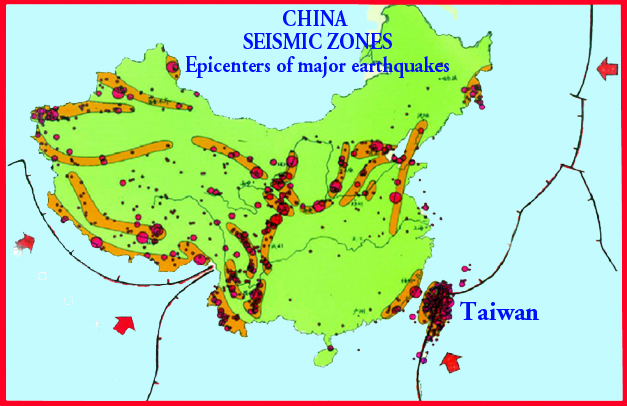 Seismotectonic Setting
The seismotectonics of China's crustal blocks are extremely complicated. The
following is only a very brief overview.
China's
Seismic Zones (modified graphic of China
Earthquake Administration)
The
high seismicity of central and eastern Asia results from
the northward collisional
convergence
(at
about
50
mm/y)
of the
India
tectonic
plate against the Eurasian plate. This active collision
- which begun about 55 million
years
ago -
is the cause of frequent large earthquakes between India and Tibet
and throughout Tibet and the surrounding areas. The convergence
has uplifted
the Asian highlands and the Tibetan Plateau to an average elevation
of over
16,000 feet - the highest and largest plateau
on Earth - with hundreds
of kilometers of displacement of crustal blocks to the east and
southeast in the direction of China.
As
India kept on moving northward and intruding into Asia by
as much as 1,200 kms, the regions north of the Himalayas
moved laterally to the east and southeast along large strike
slip faults such as the Altyn Tagh, pushing into central
China and furthermore resulting in the extrusion and movement
of the crustal blocks that formed Indochina.
 Collision
of the India and Asia tectonic plates resulting in uplift of the Himalayas
and of the Tibetan Plateau and its convergent extension into China
(modified graphic Univ. of Berne, Inst. of Mineralogy).
Collision
of the India and Asia tectonic plates resulting in uplift of the Himalayas
and of the Tibetan Plateau and its convergent extension into China
(modified graphic Univ. of Berne, Inst. of Mineralogy).
Three
distinct deformational episodes that occurred 200- 240 million
years ago resulted in initial thrusting and subsequent vertical
extrusion, while later episodes resulted in folding (Li
et al. 2007). This convergence has formed
the most active and extensive seismic belt in China - a zone
which extends from the Gansu and Nixian provinces in the
north to the Sichuan and Yuan provinces in the south.

Tibetan
Plateau crustal extension and effects of syntaxis on
the formation of major fault zones and on crustal motions
in Southcentral China - as indicated by GPS measurements (web
graphic http://www.shangri-la-river-expeditions.com/wchinageo/crustalshear.jpg)
 Detachment
of the upper crust in the Sichuan Basin of central China
which has resulted in the formation of anticlinal folds,
ridges, linear mountains and hills, widely separated by
interfold segments (poorly-formed synclines) , and major
fault zones (Landsat-1 image). The
geomorphological features of the region also control the
flow of major rivers and the formation of sedimentary accretion
zones where - often - cities are located (a factor which
also contributes to the destructiveness of earthquakes
in this region by enhancement of ground motions and
liquefaction).
Detachment
of the upper crust in the Sichuan Basin of central China
which has resulted in the formation of anticlinal folds,
ridges, linear mountains and hills, widely separated by
interfold segments (poorly-formed synclines) , and major
fault zones (Landsat-1 image). The
geomorphological features of the region also control the
flow of major rivers and the formation of sedimentary accretion
zones where - often - cities are located (a factor which
also contributes to the destructiveness of earthquakes
in this region by enhancement of ground motions and
liquefaction).
Seismicity
of the Sichuan Province
Present
day seismicity of the Sichuan Province is caused by the
slower-moving lateral crustal displacements which converge
from the margins
of the high Tibetan Plateau towards
the Sichuan Basin and
southeastern China.
This deformation
from the plateau results in additional extrusion of
crustal materials which are pushed under the weaker sedimentary
layers of the Sichuan
Basin and of the entire southeastern
region of China.
These
crustal displacements along this seimic belt are responsible
for the large destructive earthquakes in the more densely
populated areas
of Southwestern China. Thus, Sichuan is among
the most seismically active regions – where
frequent strong (M ≥ 6.5)
earthquakes can occur. The seismicity of the
region can be divided into two sub-regions, the Western
Sichuan/Eastern Yunnan and the Western
Yunnan. Earthquakes in the western
Sichuan - eastern Yunnan sub-region occur mainly in
the northwestern trending Xianshuihe and the north-trending
Xiaojiang fault systems (Zhang
et al.)
The
Provinces of Yunnan and Sichuan are seismically active
regions. Many
earthquakes occrur along the Xianshuihe fault zone (Papadimitriou
et al., 2004),
which have caused a great number of casualties and significant
damage to property. Since
the beginning of documented history in the region 1500 years
ago, there have been 32 earthquakes with
Ms > 7 (Gu,
1983; Ma, 1989).
Two events among them had magnitudes Ms > 8.
Earthquakes in this region are
characterized by shallow strike-slip faulting and focal depths
ranging from 10 and 15 km. (Allen et al.,
1989; Zhou et al., 1983).
The
Xianshuihe fault - The
Xianshuihe faulthis fault extends for about 450
km. It is a long left-lateral strike-slip fault zone with
an estimated Holocene slip rate
of about13 mm/yr (Zhang et al.; Papadimitriou
et al., 2004.
Nine earthquakes with Ms > 7 reportedly have occurred
along this fault zone. The 1973 Luhuo earthquake (Ms = 7.9) was associated
with 90 km
of surface rupture and a maximum left-lateral displacement of 6 meters (Tang
et al., 1984). To the south, the Xianshuihe fault curves
into the north-south trending Xiaojiang fault. This segment is also reported
to be a source of
major earthquakes - such as the 1833 Songming earthquake (Ms = 8).
 The
Longmeng Shan fault - Tectonic stresses from the
strong convergences have resulted in
the formation of other major faults in Sichuan Province -
such as the Longmeng Shan where the May 12, 2008 occurred.
Actually,
the Longmen Shan fault system is a boundary zone on
the northwestern margin of the Sichuan Basin, in the
inner part of the South China craton. This fault system separates
a crustal block known as " Bikou" on the west from
the Hannan complex on the east.
The
Longmeng Shan fault - Tectonic stresses from the
strong convergences have resulted in
the formation of other major faults in Sichuan Province -
such as the Longmeng Shan where the May 12, 2008 occurred.
Actually,
the Longmen Shan fault system is a boundary zone on
the northwestern margin of the Sichuan Basin, in the
inner part of the South China craton. This fault system separates
a crustal block known as " Bikou" on the west from
the Hannan complex on the east.
The
Longmen Shan fault zone consists of the fold-thrust
belt and some
strike–slip
faults such as the sinistral Yangpingguan transpressional fault.
The present-day recorded deformations include
the early ductile thrust zone, the subsequent brittle–ductile
sinistral strike–slip zone, the last dextral brittle
strike–slip
fault caused by the Indosinian orogeny(Li
et al. 2007) - and subsequent crustal
movements emanating from the Thibetan Plateau.
Segment
of the
Longmen Shan thrust belt, to the northeast of the stricken
region separating the "Bikou" block from the South China
Block (the Yangtze craton (section
of graphic from Li et al., 2007). Note
direction of crustal movement, overall orientation of
the belt, and
its approximate
match with
the fault plane (NST=228) of the 12 May
2008 earthquake (it changes somewhat direction west of Chengdu.
 Several
destructive earthquakes have occurred in the past and
in sequence along the Longmen Shan fault zone.
As indicated previously, this fault belt includes the
Luhuo, Daofu, Kangding, Qianning and
Ganzi faults - all of which have produced in recent times,
and in sequence, earthquakes with magnitude greater
than 6.0. In
fact, since 1893 there have been many more successive
strong earthquakes along this zone. These earthquakes appear
to
migrate along
the
strikes of the major faults, as a result of tectonic
stress transference and enhancement. Thus,
additional strong earthquakes can be expected in the
future along adjacent
segments
of this fault zone –as well as along other
parallel zones.
Several
destructive earthquakes have occurred in the past and
in sequence along the Longmen Shan fault zone.
As indicated previously, this fault belt includes the
Luhuo, Daofu, Kangding, Qianning and
Ganzi faults - all of which have produced in recent times,
and in sequence, earthquakes with magnitude greater
than 6.0. In
fact, since 1893 there have been many more successive
strong earthquakes along this zone. These earthquakes appear
to
migrate along
the
strikes of the major faults, as a result of tectonic
stress transference and enhancement. Thus,
additional strong earthquakes can be expected in the
future along adjacent
segments
of this fault zone –as well as along other
parallel zones.
Precursor
Observations and Unusual Animal Behavior
Most
of the precursor events and phenomena that were recorded
or observed were spread over a wide geographical area and
thus were not of value in estimating where or when a large
earthquake would strike. For example, there was a report
that large amounts of water suddenly disappeared from
a pond in Enshi
city in Hubei province - but that was around 350 miles east
of the epicenter of the May 12, 2008 earthquake. However, closer
to the epicenter and three days before the earthquake, thousands
of toads reportedly roamed the streets of Mianzhu. Mianzhu
residents feared the toads were a sign of an approaching
natural disaster, but a local forestry bureau official said
it was normal, the Huaxi Metropolitan newspaper reported
May 10,
two days before the earthquake. Mianzhu
was a hard-hit city where 2,000 or more
people were killed.
The day of the earthquake, zebras were banging
their heads against a door at the zoo in Wuhan, more than 600
miles east
of the epicenter,
according to the Wuhan Evening Paper. Elephants
swung their trunks wildly, almost hitting a staff member. The 20
lions and tigers, which normally would be
asleep at midday,
were walking around. Five minutes before the quake hit,
dozens of peacocks started screeching.
REFERENCES
and ADDITIONAL READING
Allen,
C.R., Luo Zhuoli, Qian Hong, Wen Xueze, Zhou Huwei, and Huang
Weishi, (1989), Segmentation and rupture history of the Xianshuihe
fault, southwestern China, U. S. Geological Survey Open-File
Report 89-315, 10-31.
Gu
Gongxiu, (1983), Earthquake Catalog of China, Seismological
Press.
Hui-
Lan Zhou, Clarence R. Allen and Hiroo Kanamori, " Rupture
complexity of the 1970 Tonghai and 1973 Luhuo earthquakes,
China, from P-wave inversion, and relationship to surface
faulting". Bulletin of the Seismological
Society of America; December 1983; v. 73; no. 6A; p.
1585-1597.
Ma
Xingyuan, (1989), Lithospheric dynamics atlas of China, China
Cartographic Publishing House, Beijing.
Pararas-Carayannis, George, 2006, Earthquakes in China, Excerpts from Unpublished Manuscript. http://www.drgeorgepc.com/EarthquakesChina.html
Pararas-Carayannis, George, 2006. The Tansgshan Earthquake of July 28, 1976, http://www.drgeorgepc.com/Earthquake1976ChinaTangshan.html
Pararas-Carayannis, George, 1975, The
Earthquake of February 4, 1975 in Haicheng, China, http://www.drgeorgepc.com/Earthquake1975ChinaHaicheng.html
Pararas-Carayannis, George, 2000. Earthquake Prediction in China - Monitoring Animal Behavior, (Excerpts from Unpublished Manuscript), http://www.drgeorgepc.com/EarthquakePredictionChina.html
Pararas-Carayannis, George, 1999, The Earthquake of 20 September 1999 in Taiwan, http://www.drgeorgepc.com/Earthquake1999Taiwan.html
Pararas-Carayannis, George, 2006, The
Earthquake and Tsunami of July 18, 1969 in the Bohai Sea,
China, http://www.drgeorgepc.com/Earthquake1969ChinaBohai.html
Pararas-Carayannis, George, 2000, DISASTER RISK ASSESSMENT OF THE CHINA/TAIWAN CROSS-STRAITS REGION, Planning for Disaster Mitigation, Keynote Presentation
2009 China Cross-Straits Symposium on the Prevention and Mitigation of Natural Hazards - 19-20 JUNE 2009, FUZHOY, CHINA,
http://www.drgeorgepc.com/CrossStraits.pdf (PDF in English); http://www.dregeorgepc.com/CrossStraitsCH.pdf (PDF in Chinese)
Papadimitriou,
Eleftheria; Wen, Xueze; Karakostas, Vassilios; Jin, Xueshen, "Earthquake
Triggering along the Xianshuihe Fault Zone of Western Sichuan,
China", Pure & Applied Geophysics PAGEOPH,
Volume 161, Number 8, August 2004 , pp. 1683-1707(25)
Sanzhong
Li, Timothy M. Kusky, Lu Wang , Guowei Zhang , Shaocong Lai,
Xiaochun Liu, Shuwen Dong,
Guochun Zhao. (In Press). "Collision
leading to multiple-stage large-scale extrusion in the Qinling
orogen:
Insights from the
Mianlue suture". International Association for Gondwana
Research. Elsevier (2007)
Zhang
Qiu-wen, Zhang Pei-zhen , Wang Cheng , Wang Yi-peng and Michael
A Ellis, "Earthquake triggering
and delaying caused by fault interaction on Xianshuihe fault
belt, southwestern
China". Seismological Society of China, Volume 16,
Number 2 / March, 2003.
Zhou
Huilan, Liu H.-L., and H. Kanamori, (1983), Source processes
of large earthquakes along the Xianshuihe fault in southwestern
China, Bull. Seism. Soc. Am., 73, 171-181.
Peizhen
Zhang, Zhi-xian Yang, H. K. Gupta, S.C. Bhatia, Kaye M. Shedlock,
Global Seismic Hazard Assessment Program (GSHAP) in Continental
Asia.
SEE
ALSO: